
Cumberland County Court Records After a Jail Arrest
After a Cumberland County arrest, the court record is not the same thing as the jail record. The jail record is created for custody at Piedmont Regional Jail, the regional jail serving Cumberland County from Farmville. It may list arrest charges, booking date, bond fields, holds, release date, and possibly an image field. The court record is created or updated when a warrant, summons, complaint, indictment, appeal, or other filing enters the Virginia court system.
Cumberland County uses the Virginia title Commonwealth's Attorney for the prosecutor. The Cumberland County Commonwealth's Attorney, Wendy Hannah, prosecutes criminal offenses occurring within the county, including traffic offenses, misdemeanors, and felonies. The office handles cases in Circuit Court, General District Court, and Juvenile and Domestic Relations District Court. That means court records after an arrest should be checked through the court system and clerk channels, while jail inmate records remain the place to confirm current custody and jail mugshots remain the booking-photo topic.
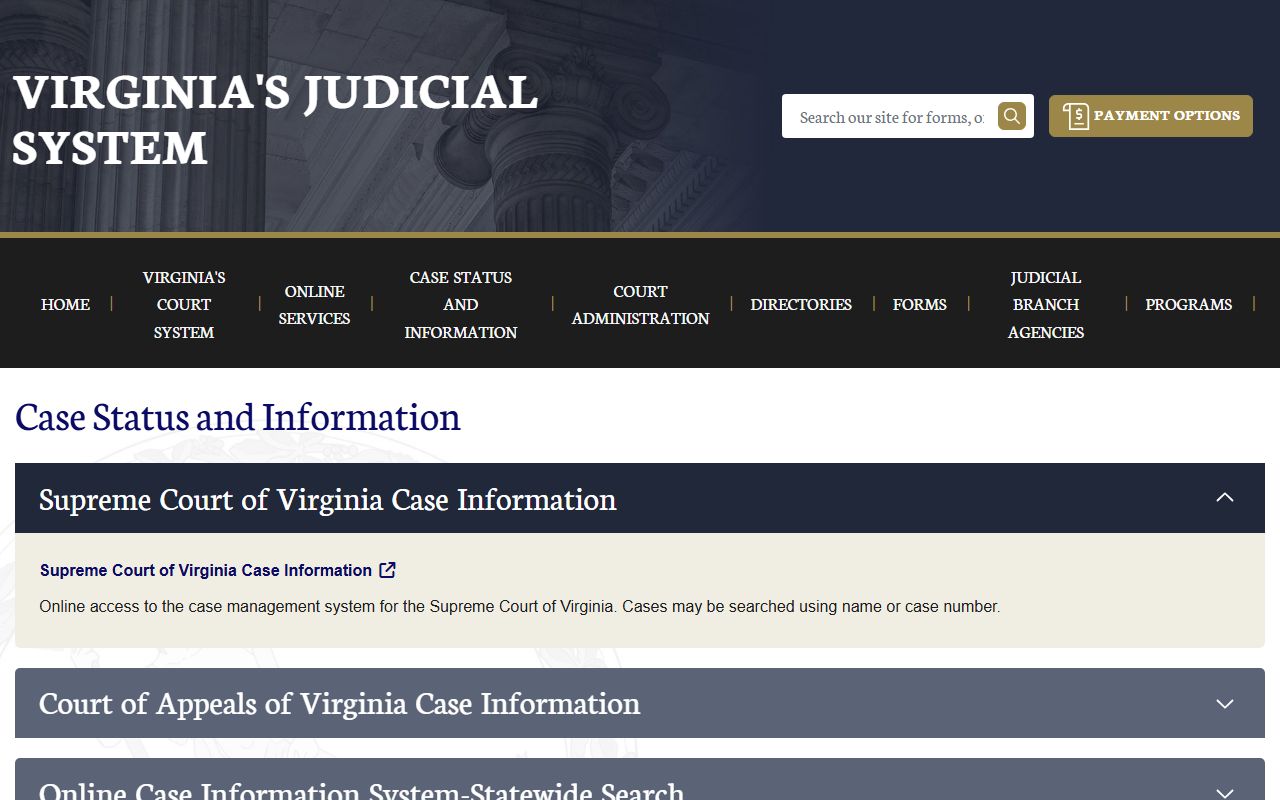
The Virginia courts case information page is the official starting point for court-system searches. The manifest image below comes from the Virginia Case Status and Information page, which links to statewide and court-specific case systems.
How to Find Cumberland County Court Records After an Arrest
Start with the custody side only long enough to collect search clues. The PRJ offender lookup may provide the booking charge, arresting agency, booking date, bond field, court date, case number, warrant number, or charge status. Those jail details can help locate the court case, but the court record controls the filed charge, hearing schedule, and disposition.
- Open the Virginia Case Status and Information page and choose the system that matches the case stage.
- Search Cumberland General District Court by defendant name, case number, or hearing date for traffic cases, misdemeanors, and many felony preliminary hearings.
- Search Circuit Court information for felony indictments, appeals from lower court, and circuit-level dispositions. The Cumberland Circuit Court Clerk also handles criminal files at 1 Courthouse Circle.
- Open the case and read each charge separately. Look for charge wording, statute references, court date, court type, bond or bail notes, and current status.
- If the matter involves Juvenile and Domestic Relations Court, expect limits. Cumberland's prosecutor page says juvenile and domestic pending cases are not available online.
Useful search channels include the statewide OCIS portal for adult criminal and traffic case information, the General District Court Online Case Information System, Circuit Court Case Information, clerk contact for older or unavailable files, and Virginia VINE/VINELink for custody and criminal case notifications. For a full criminal history, fingerprint-based or official background-check procedures are different from a public case lookup and should not be treated as identical to a courthouse search.
| Portal or Office | Access Method | Best Use |
|---|---|---|
| Virginia Case Status and Information | Official system landing page | Choose OCIS, General District, Circuit, or JDR payment/case tools. |
| OCIS Statewide Search | Statewide online search | Adult criminal and traffic information in covered courts. |
| General District Court Online Case Information | Name, case number, or hearing date | Traffic, misdemeanor, and felony preliminary hearing matters. |
| Cumberland Circuit Court Clerk | In person, mail, or phone at 804-492-4442 | Criminal files, felony cases, appeals, and records not located online. |
How Charges Get Filed After an Arrest: Warrant, Summons, and Indictment
A Cumberland County arrest may begin with a warrant, a summons, a complaint before a magistrate, or another law-enforcement action. Once the person is booked or released on conditions, the court side develops through filed charging documents. Virginia practice does not fit every case into the generic complaint, information, and indictment labels used in some states, so the safer local framing is warrant or summons for initial district-court matters, complaint or petition in appropriate contexts, and indictment for many felonies that move to Circuit Court after grand jury action.
| Document | Who Uses It | Common Role After Arrest |
|---|---|---|
| Warrant or summons | Magistrate, officer, or court process | Starts or records the charge that brings the defendant into court after an arrest or citation. |
| Complaint or petition | Law enforcement, complainant, or court process | Supplies the accusation or case basis, including some juvenile or domestic matters. |
| Preliminary hearing certification | General District Court | Moves a felony toward grand jury review when probable cause is found. |
| Indictment | Grand jury in Circuit Court | Formal felony charge returned for Circuit Court prosecution. |
| Appeal record | Court clerk | Carries a misdemeanor or traffic appeal from lower court into Circuit Court. |
Charge Status in Court Records After an Arrest
Charge wording can change between booking and court. A jail roster may show the arrest charge entered at intake, while the prosecutor may amend, reduce, dismiss, nolle prosequi, or pursue a different charge after reviewing the facts. Read every status line independently. One charge may be dismissed while another remains pending, and a bond or hold can continue even when a separate charge changes.
| Status | What It Means |
|---|---|
| Pending | The case or charge is active and has not reached final disposition. |
| Preliminary hearing | A General District Court stage where probable cause is considered for many felony charges. |
| Certified to grand jury | The felony has advanced from preliminary hearing toward Circuit Court grand jury review. |
| Indicted | A grand jury has returned a formal felony charge for Circuit Court. |
| Amended or reduced | The charge changed from the original listing, often by prosecutor action or court order. |
| Dismissed | The charge ended by court order and did not result in conviction on that charge. |
| Nolle prosequi | The prosecutor declined to proceed at that time. It is not the same word as acquittal. |
| Convicted | The court found guilt or accepted a plea on that charge. |
| Deferred | The case is held under conditions before final disposition. |
Bond and Release After an Arrest
Bond is controlled by Virginia criminal procedure, the magistrate, and the court, not by a website result alone. PRJ may hold the person and the JailTracker metadata includes BondType and BondAmount fields, but a displayed bond field should be verified before money is posted. Call PRJ at (434) 392-1601 when the roster is unclear and ask whether the person is eligible for release, whether another hold exists, and which court or magistrate controls the condition.
| Bond Type | How It Works |
|---|---|
| Recognizance or personal recognizance | Release based on a signed promise to appear and obey conditions, without posting the full bond amount. |
| Unsecured bond | A monetary amount is set but usually becomes due only if the defendant fails to comply. |
| Secured or cash bond | Release requires money or approved security to be posted through the proper court or bond channel. |
| Surety bond | A licensed surety or bondsman guarantees the bond amount, subject to Virginia rules. |
| No-bond hold | The person remains in custody unless the court changes the release condition. |
| Detainer or hold | Another agency, sentence, warrant, probation matter, USMS matter, ICE issue, or jurisdiction can prevent release even if a Cumberland charge has bond. |
Do not confuse commissary or phone-account deposits with bond. PRJ publishes deposit methods for commissary and prepaid phone accounts, but the research did not locate an official PRJ bond-payment page for Cumberland cases. Ask the court clerk, magistrate, or PRJ records staff where a specific bond must be posted.
Warrants That Lead to an Arrest
No official Cumberland County active-warrant search page was found in the sources reviewed. The sheriff's office page confirms deputies handle civil and criminal process, and the Victim/Witness Assistance Program gives a local path for warrant questions. For misdemeanor complaints, contact the Cumberland County Sheriff's Office at 804-492-4120 and ask about speaking with a magistrate. For felony allegations, the program directs people to contact the sheriff and ask for a deputy so the matter can be investigated.
After a warrant results in arrest and commitment, the person may appear on PRJ's JailTracker roster. Court-related bench warrants or capias events may appear in the court case record. A search warrant is different because it authorizes a search rather than custody. Anyone who believes a warrant may exist should use the sheriff, court clerk, or an attorney rather than relying on unofficial warrant aggregator sites.
Charges vs. Convictions
An arrest charge is an accusation, not a conviction. A Cumberland County court record may show several charges and several outcomes. Treat the disposition line as the controlling outcome, and avoid reading a booking charge as proof that the person was convicted.
| Charge | Conviction | |
|---|---|---|
| Stage | Allegation or filed offense after arrest. | Final finding of guilt or accepted plea. |
| Where seen | Jail roster, warrant, summons, court case, or indictment. | Court disposition and sentencing record. |
| Burden | Early stages may use probable cause standards. | Criminal guilt requires proof beyond a reasonable doubt or a valid plea. |
| Meaning | Shows what was alleged or filed. | Shows the legal result on that charge. |
Sealed vs. Expunged Arrest Records
Virginia law has separate concepts for expungement and sealing. Va. Code § 19.2-392.2 covers expungement of police and court records for qualifying arrests or charges. Title 19.2, Chapter 23.2 contains criminal-history record sealing provisions effective July 1, 2026, including automatic sealing paths for certain outcomes. Neither topic should be reduced to a jail help-desk request. The court order and statutory eligibility matter.
| Sealed | Expunged | |
|---|---|---|
| Public visibility | Restricted from ordinary public access when the law or court order applies. | Police and court records are removed from ordinary access for qualifying matters under the expungement statute. |
| Trigger | Statutory sealing provisions or a qualifying court process. | Petition and court order for eligible records, such as certain dismissals or acquittals. |
| Not automatic for every arrest | Eligibility depends on the outcome and statute. | Eligibility depends on the charge history and court ruling. |
| Practical step | Ask the clerk about sealing status and access limits. | Review the statutory process and court file before assuming a record is cleared. |
Background Check Considerations
Public court lookup is not the same as a regulated employment, housing, credit, insurance, or tenant-screening background check. Court systems can show case events and dispositions, while consumer reports must follow separate federal and state rules. Verify any Cumberland County result against the originating court before making a legal, employment, or licensing judgment.
Important: This website is not a consumer reporting agency and court lookup information may not be used for FCRA-covered decisions.
Restricted Court Records After an Arrest in Cumberland County
Some records are not fully public online. Juvenile and domestic cases have different access rules, and Cumberland's own prosecutor page says JDR pending cases are not available online. Law-enforcement records may be redacted or withheld under Va. Code § 2.2-3706 when an exemption applies, including certain investigative concerns. Va. Code § 2.2-3704 provides the FOIA request process, including response procedures and charges, but it does not require an agency to create a record that does not exist. For court files, start with the Virginia court systems and the Cumberland Circuit Court Clerk. For jail or booking records, use PRJ records or Cumberland County FOIA channels depending on which office holds the record.
Public Record Search
Sponsored Results